The Secret to UGC That Scales Itself: Language Adaptation
The Secret to UGC That Scales Itself: Language Adaptation
The best UGC does not just show a product. It gives people language they want to repeat. Here is the 4-step framework behind messages that scale organically.
Published:

Read Time:

3 min

Written by:
Nafesya
Written by:
Nafesya
PEOPLE TRUST PEOPLE. THAT’S WHY UGC WORKS.
But the best UGC gives those people the exact language to share.
PEOPLE TRUST PEOPLE. THAT’S WHY UGC WORKS.
But the best UGC gives those people the exact language to share.
PEOPLE TRUST PEOPLE. THAT’S WHY UGC WORKS.
But the best UGC gives those people the exact language to share.
For UGC creators, effective communication involves helping audiences understand a product while also shaping how they interpret it through their own experience. In many cases, what people share and repeat are not product features or marketing messages, but simple expressions such as "worth every penny," "I didn't expect this to work," or "this made my life easier." These phrases tend to spread because they are easy to understand, relatable, and reusable across different contexts, highlighting the growing importance of language adaptation in UGC content.
From Convincing to Adapting
Some creator messages disappear as soon as people scroll past them. Others continue showing up in reviews, comments, and conversations long after the original content is published.
This is what we call Language Adaptation.
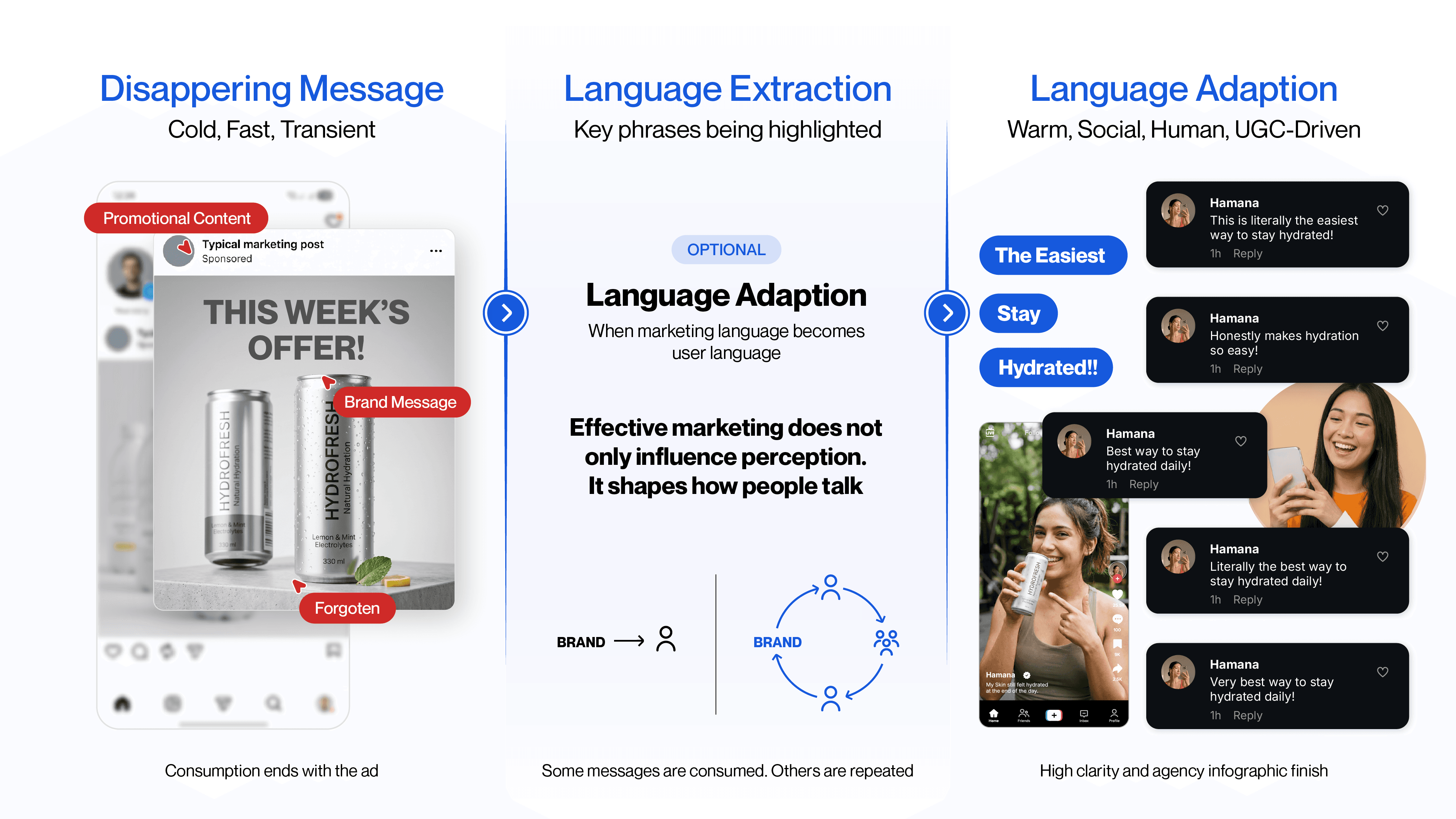
Language adaptation occurs when consumers adopt and reuse phrases, descriptions, or ways of framing a product that were originally introduced by a brand or creator. A creator may describe a product as "the easiest way to stay hydrated." Later, consumers begin using similar language in reviews, recommendations, or social media posts. The wording may change, but the underlying framing remains recognizable.
Studies on persuasive language show that some expressions tend to reappear in how people talk. The point is simple but important. Good marketing doesn’t just shape perception, it should shapes how people describe the product itself.
Why Some Messages Travel (And Others Die)
The idea behind language adaptation is simple. People share experiences more easily than they share information.
See the difference in these two statements:
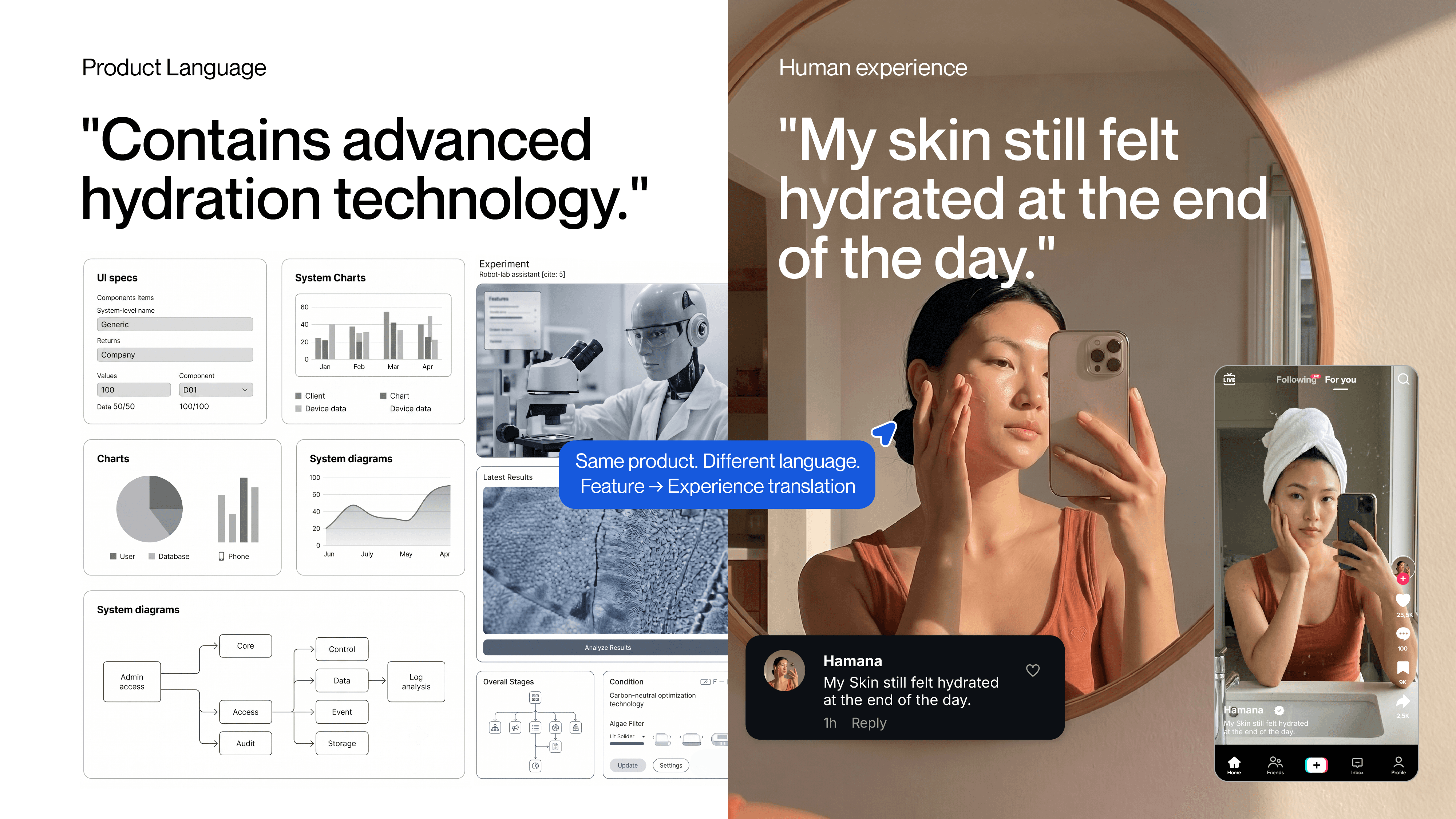
Both communicate value, but they function differently. The first describes a product. The second describes an outcome.
This distinction matters because social media spreads through conversation. Product specifications rarely appear in comments, reviews, or recommendations. Experiences, observations, and personal results do.
Research on persuasive language supports this pattern. Messages centered on useful discoveries, positive outcomes, or personal improvement tend to generate stronger engagement and wider reach. They give people something meaningful to contribute to a conversation.
This helps explain why phrases such as "worth the hype," "I wish I found this sooner," or "this made my life easier" appear repeatedly across social platforms. They sound like genuine recommendations, making them easy for audiences to incorporate into their own conversations. The messages that travel furthest are often the ones that transform product value into language people naturally use when sharing their experiences.
The 4-Step Language Framework for UGC
To design messaging that travels beyond campaigns and into organic conversation, creator can shift from “explaining products” to “designing reusable language.”
This framework breaks it into four layers:
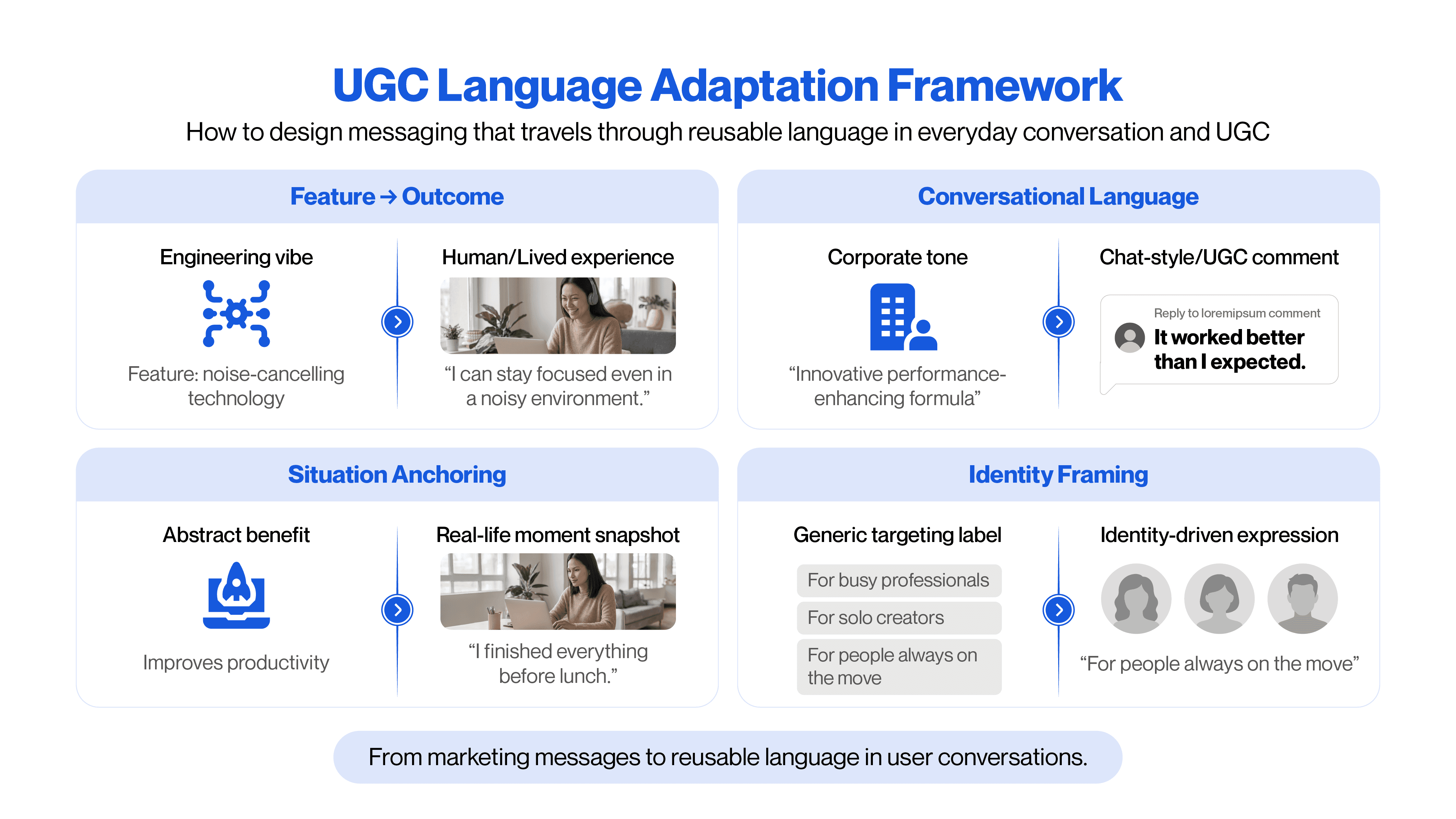
1. Feature to Outcome
Convert product features into tangible user outcomes. Emphasize the change in daily experience rather than the mechanism behind it.
Example:
Feature: noise-cancelling technology > Outcome: “I can stay focused even in a noisy environment”
2. Conversational Language
Use phrasing that reflects natural speech. Prioritize how people actually talk over how brands typically write.
Example:
“Innovative performance-enhancing formula” > “It worked better than I expected”
3. Situation Anchoring
Ground messages in specific, recognizable moments. Concrete scenarios are easier to visualize, remember, and repeat.
Example:
“Improves productivity” > “I finished everything before lunch”
4. Identity Framing
Connect messaging to self-expression. Strong messages allow people to use the product as a way to describe who they are.
Example:
“For busy professionals”
“For solo creators”
“For people always on the move”
UGC is often discussed as a content format problem: what creators should post, how campaigns should be structured, or how incentives should be designed. But underneath all of that is a more fundamental layer:
“The best-performing UGC doesn’t just show the product. It speaks a language that other people want to use.”
Scale Your Creative Engine
Managing creator networks, content production, and campaign logistics at scale can quickly overwhelm internal teams.
Masterhooks handles the entire process, from creator sourcing and scripting to content execution, helping brands build authentic, high-converting UGC libraries designed to capture attention and drive growth.
Audit your creative strategy today

Audit your creative strategy today
For UGC creators, effective communication involves helping audiences understand a product while also shaping how they interpret it through their own experience. In many cases, what people share and repeat are not product features or marketing messages, but simple expressions such as "worth every penny," "I didn't expect this to work," or "this made my life easier." These phrases tend to spread because they are easy to understand, relatable, and reusable across different contexts, highlighting the growing importance of language adaptation in UGC content.
From Convincing to Adapting
Some creator messages disappear as soon as people scroll past them. Others continue showing up in reviews, comments, and conversations long after the original content is published.
This is what we call Language Adaptation.
Language adaptation occurs when consumers adopt and reuse phrases, descriptions, or ways of framing a product that were originally introduced by a brand or creator. A creator may describe a product as "the easiest way to stay hydrated." Later, consumers begin using similar language in reviews, recommendations, or social media posts. The wording may change, but the underlying framing remains recognizable.
Studies on persuasive language show that some expressions tend to reappear in how people talk. The point is simple but important. Good marketing doesn’t just shape perception, it should shapes how people describe the product itself.
Why Some Messages Travel (And Others Die)
The idea behind language adaptation is simple. People share experiences more easily than they share information.
See the difference in these two statements:
Both communicate value, but they function differently. The first describes a product. The second describes an outcome.
This distinction matters because social media spreads through conversation. Product specifications rarely appear in comments, reviews, or recommendations. Experiences, observations, and personal results do.
Research on persuasive language supports this pattern. Messages centered on useful discoveries, positive outcomes, or personal improvement tend to generate stronger engagement and wider reach. They give people something meaningful to contribute to a conversation.
This helps explain why phrases such as "worth the hype," "I wish I found this sooner," or "this made my life easier" appear repeatedly across social platforms. They sound like genuine recommendations, making them easy for audiences to incorporate into their own conversations. The messages that travel furthest are often the ones that transform product value into language people naturally use when sharing their experiences.
The 4-Step Language Framework for UGC
To design messaging that travels beyond campaigns and into organic conversation, creator can shift from “explaining products” to “designing reusable language.”
This framework breaks it into four layers:
1. Feature to Outcome
Convert product features into tangible user outcomes. Emphasize the change in daily experience rather than the mechanism behind it.
Example:
Feature: noise-cancelling technology > Outcome: “I can stay focused even in a noisy environment”
2. Conversational Language
Use phrasing that reflects natural speech. Prioritize how people actually talk over how brands typically write.
Example:
“Innovative performance-enhancing formula” > “It worked better than I expected”
3. Situation Anchoring
Ground messages in specific, recognizable moments. Concrete scenarios are easier to visualize, remember, and repeat.
Example:
“Improves productivity” > “I finished everything before lunch”
4. Identity Framing
Connect messaging to self-expression. Strong messages allow people to use the product as a way to describe who they are.
Example:
“For busy professionals”
“For solo creators”
“For people always on the move”
UGC is often discussed as a content format problem: what creators should post, how campaigns should be structured, or how incentives should be designed. But underneath all of that is a more fundamental layer:
“The best-performing UGC doesn’t just show the product. It speaks a language that other people want to use.”
Scale Your Creative Engine
Managing creator networks, content production, and campaign logistics at scale can quickly overwhelm internal teams.
Masterhooks handles the entire process, from creator sourcing and scripting to content execution, helping brands build authentic, high-converting UGC libraries designed to capture attention and drive growth.
Audit your creative strategy today
Related Reading
Related Reading

Why Pretty Little Liars and The Love Hypothesis Are Going Viral in the Same Week
5 min
|
Why Pretty Little Liars and The Love Hypothesis Are Going Viral in the Same Week
Learn how Pretty Little Liars and The Love Hypothesis turn fans into engines for fan-generated content, and what brands can learn about community-led growth.
5 min
|

What Is a Content Pillar? (And How to Build One That Actually Works for UGC)
4 min
|
What Is a Content Pillar? (And How to Build One That Actually Works for UGC)
Learn what a content pillar is, why it matters for UGC, and how to build a practical content pillar strategy with creator briefs and real examples.
4 min
|

First Day of Fall, First Day of Content: The UGC Formats That Win in October
4 min
|
First Day of Fall, First Day of Content: The UGC Formats That Win in October
Discover five October UGC formats brands can use this fall, from seasonal transitions and cozy routines to Halloween teasers and reset content.
4 min
|


Need help scaling?
Book a strategy call with our expert team to audit your current UGC setup.